
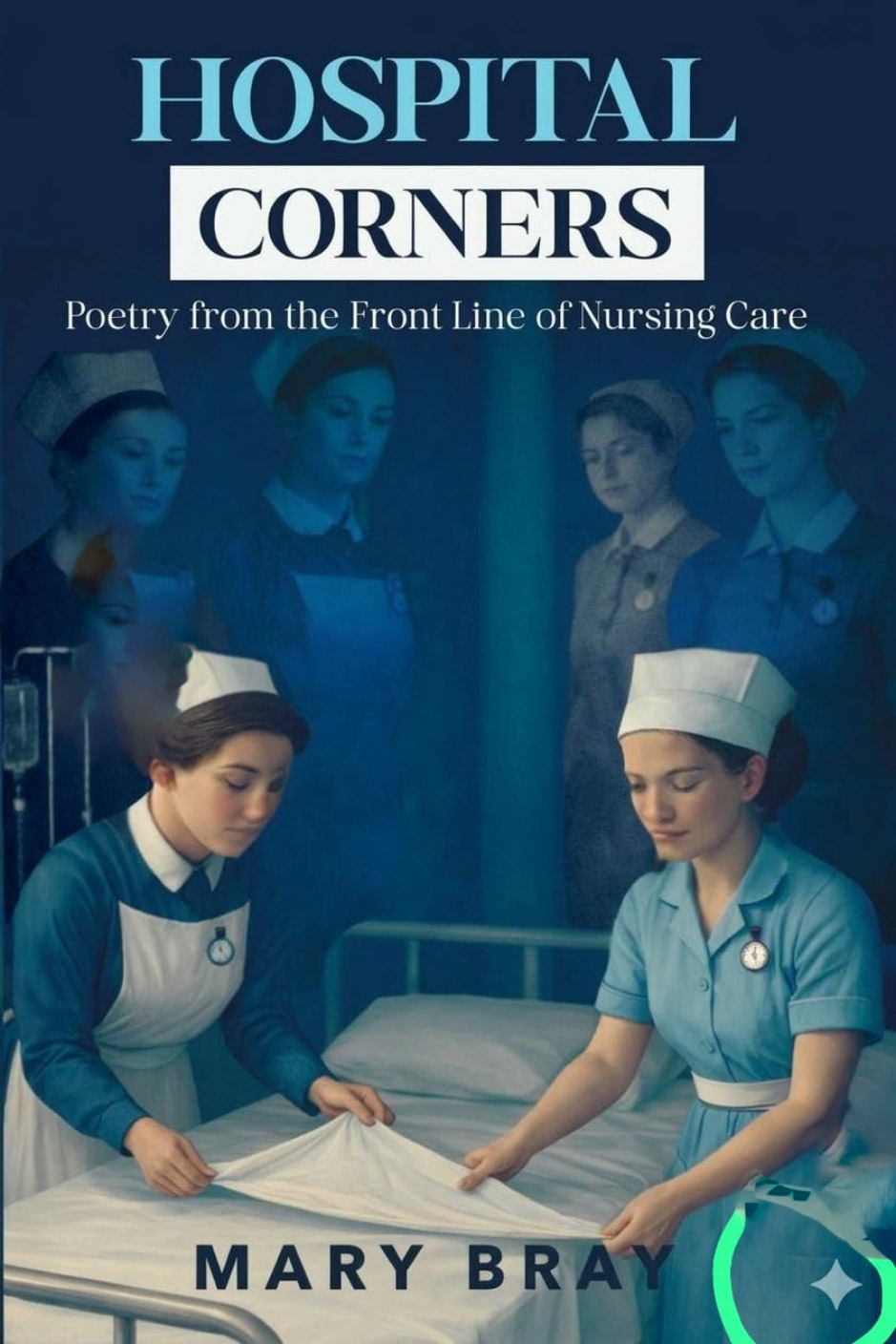
Hospital Corners:
Nursing has shaped my life for more than forty years. It has been my work, my education, my community, and often my compass.
I still remember the quiet gravity of the night shift—standing in a dim corridor, the sharp scent of carbolic in the air, watching over a ward where “darky, clotted shadows creep into corners.” In those hollow hours before dawn, when fear and solitude felt heaviest for a patient, a nurse’s presence was everything. Over those decades, I’ve watched the profession shift and stretch from the lingering shadow of Florence Nightingale’s starch-apron legacy to the modern, academic tides of healthcare. Yet, its heart has remained astonishingly constant: Compassion. Presence. Dignity. These threads endure
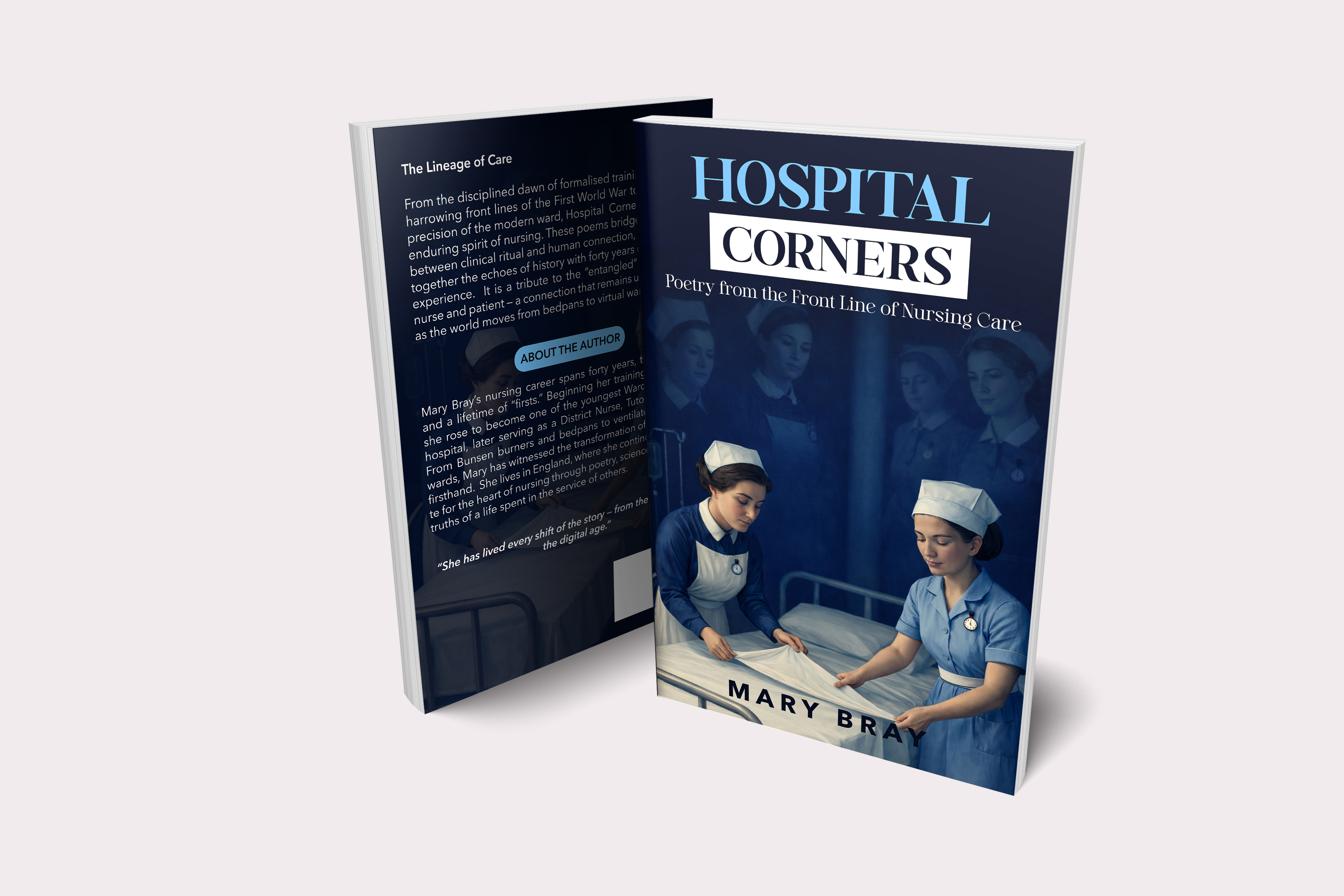
About the Cover: The artwork for Hospital Corners reflects the deep, historical lineage of care. It bridges the past and the present, capturing that timeless moment where a nurse’s hands bring order, comfort, and peace to a bedside.
A Mosaic of Lived Experience
Hospital Corners grew out of that constancy. It isn’t a linear history or a traditional memoir. Instead, it’s a mosaic of poetry and prose: fragments of lived experience, echoes from the old nurses’ homes, stories passed between colleagues, and glimpses into the long lineage of care that came before us.
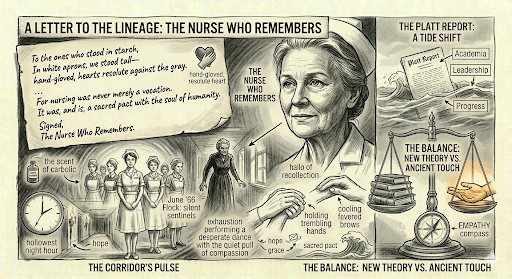
The Nurse Who Remembers:
This collection balances the evolution of modern medical theory against the ancient, irreplaceable touch of empathy—holding trembling hands, cooling fevered brows, and navigating the corridor’s pulse with a resolute heart.
Some pieces are rooted in historical accounts marvelling at the stoicism and bravery of nurses under fire back to the 1800s. Others are deeply personal memories, or shared stories entrusted to me by fellow “silent sentinels” who have carried their own quiet triumphs and private griefs.
What binds these moments together is the voice of nursing itself—the hand held in silence, the unique humour that gets a team through a grueling shift, and the resilience that rises even when systems strain and falter. The tension between compassionate care and institutional constraint is something every nurse knows intimately. It appears in wartime wards, in overstretched hospitals, and in the bureaucratic tangles that threaten to overshadow human work. And yet, within that tension, there is always humanity. This book is my way of honouring that humanity.
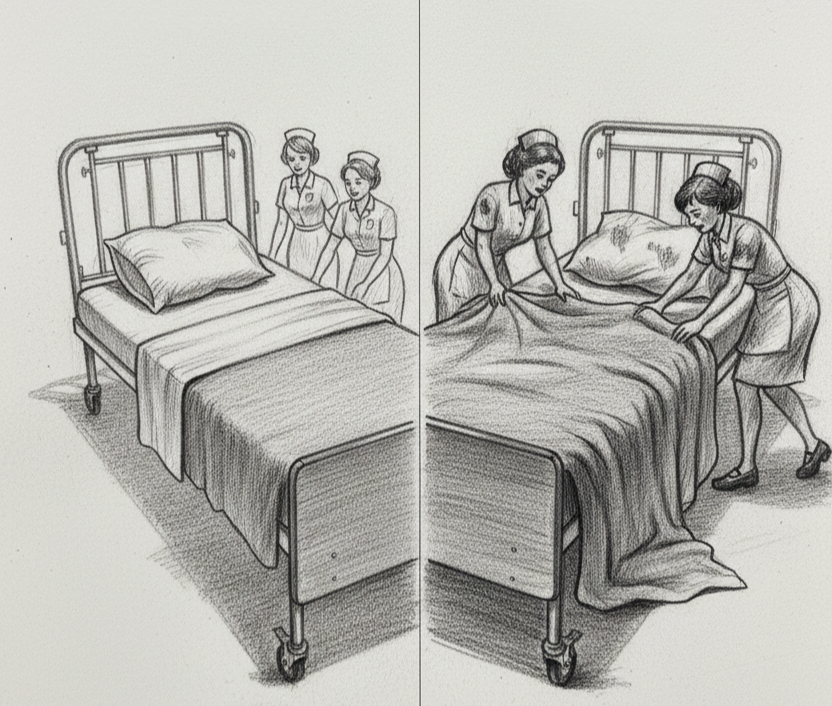
Making the Bed, Making Space to Reflect
The Ritual of the Craft: There is an art to a perfectly turned hospital corner. It represents discipline, structure, and the literal smoothing away of discomfort for the person lying in that bed.This book is not a definitive account of medicine, nor does it try to resolve the contradictions of our healthcare systems. Instead, it offers recognition. A place to pause. A reminder that nursing is, at its core, a profoundly human endeavour, shaped not by policies or protocols, but by the courage, humour, and grace of those who choose to care.If you’ve ever worn the uniform, loved someone who has, or simply wondered what lies behind the curtain of the ward, I hope Hospital Corners speaks to you. I hope it stirs memory, sparks reflection, or offers solace.
Over To You
For the caregivers: What memory or quiet moment from your time on the wards stays with you the most?
For the patients and loved ones: Have you ever experienced a moment where a simple, quiet presence made all the difference?
I would love to hear your thoughts and reflections in the comments below.
Dawn on the Nightingale Ward
Dawn arrives quietly, almost shy,
a thin grey seep of light along the windows
that softens the hard edges of the night.

The shadows retreat first  those long,
unsettling shapes  that made the ward
feel larger than it was.
Now they fold themselves back
into corners and under beds,
as if embarrassed by their own boldness
Dark humps in beds resolve into people.

The smells change too.
Antiseptic still clings to the air,
but the night’s heavier scents —
warm bodies, sweat, fear,
the sour breath of disturbed sleep
begin to thin as the cool morning drafts
slip through the vents.

The green‑shaded lamps over the sickest patients
  lose their eerie glow,
as they nurses remove the shades
their underwater light now golden
as the real day gathers strength.

Snuffles settle.  Snores soften.
The mutterer in bed nine
falls into a quieter rhythm.
Even the shouter seems spent,
their voice now only a faint, restless murmur.

And you — junior, tired,
eyes gritty from the long watch
feel the ward exhale.
Your own shoulders drop
as the first proper light touches the floor,
revealing the familiar shine of polish,
then you have the final sprint to the finish
the list of tasks to complete
before the Ward Sister arrives.
Thank you for reading I hope some of you will comment either on your experiences as nurse or how you saw the nurses from a different angle.
 Converging Lives. Sounds, Silence and Imagery