
Hospital Corners Series Part 2.
The mid-1960s were defined by a seismic cultural shift—the music was louder, skirts were shorter, and youth culture was rewriting the rules of freedom. Yet, for a young woman stepping across the threshold of the Hospital Nurses’ Home, time didn’t just slow down; it snapped backward into a world governed by Victorian discipline, military precision, and a relentless devotion to duty.
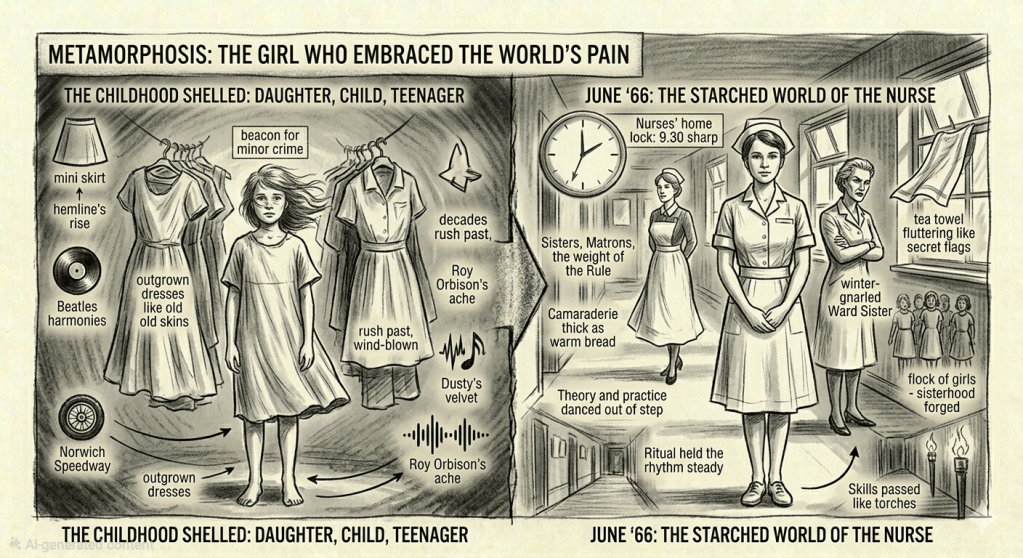
Entering State Registered Nurse (SRN) training meant undergoing a literal and psychological transformation, beginning the moment you stepped out of your civilian clothes and into a uniform that felt more like armor than apparel. The poems Metamorphosis and Uneven Laces capture this exact, jarring pivot point.
Why I wrote “Hospital Corners”
As a former nursing student who survived the rigor of a highly disciplined training and progressed by walking these corridors to nurse educator, I realized how quickly the true story of our profession is being forgotten.
Today, people look at nursing and see a modern career, but its roots were deeply imbued with a military-style discipline. For generations, entering this life meant surrendering your personal freedom—enduring grueling hours, strict curfews, and zero allowance for outside relationships. In fact, until the end of the Second World War, even fully trained nurses weren’t permitted to marry; the moment you said “I do,” you were dismissed from service.
By the time I entered training in the 1960s, that absolute control had begun to soften, but the echo of it remained incredibly strong. It was a monumental shock for young, free spirits to suddenly adapt to such an unyielding structure. I wrote this collection to capture that hidden, fragile transition—to remind people of the fierce, quiet discipline it took to become the hands that care.
Metamorphosis
The decades rush past, wind-blown and wild,
as she slips through the skins of her younger selves.
The child, the girl, the teenager—old identities hung in the cupboard like outgrown dresses,
held to the light to see what still carries her scent.
She grew in the era of the hemline’s rise,
Beatles harmonies stitched into her bones.
Roy Orbison’s ache and Dusty’s velvet,
the Stones’ swagger humming in the blood,
while Friday nights at the Norwich Speedway
roared like caged storms—burnt rubber and grease
turning the heart soft as tallow to Halfway to Paradise.
School was a rattling coaster,
her height a beacon for every minor crime.
The Eleven-plus failed, a door seemingly slammed,
until O-levels cracked it open again.
At fourteen, a dream of nursing or teaching;
at sixteen, she stepped out of the classroom
and into the waiting light.
Two years to fill: of small hands and big feelings,
she stood guard in playground winds,
tying shoelaces and reading stories to the small,
while night school claimed her evenings.
Then came June of ’66:
a flock of girls stepping into a starched world,
a life ruled by the sudden strike of bells,
by Sisters, Matrons, and the weight of the Rule.
The Nurses’ Home locked its doors at half-past nine,
but freedom was unscrewed from window frames
tea towels fluttering like secret flags into the night.
A sisterhood forged in whispered laughter,
the shared, electric thrill of sneaking in late
against a world that demanded seclusion.
Hospitals then were different creatures:
Matrons gliding with the silent grace of swans,
Ward Sisters gnarled and sharp as winter wood.
Yet the student nurses were the beating heart,
the pulse in the corridor, the heat in the air.
Theory and practice danced out of step,
but ritual held the rhythm steady—hand to hand.
Skills were passed like torches in a dark hall,
a camaraderie thick and warm as fresh bread.
Out of the discipline, the care, and the chaos,
they emerged:
Competent. Confident.
Ready, finally, to carry the world’s pain.
The Anatomy of the Transformation
To the outside world, the traditional nurse’s uniform—the pristine apron, the starched cap, the different colour belt—was a symbol of comfort and untarnished mercy. To the young woman wearing it for the first time, it was an exhausting, rigid architecture.
• The “Shoebox” Shoes: Before a junior nurse could ever comfort a patient, she had to conquer her own footwear. Regulations demanded heavy, flat, shiny black leather shoes. Brand new, they felt like stiff boxes, biting into heels and arches during relentless twelve-hour shifts on unyielding floors.
• The Discipline of the Cap: The nurse’s cap wasn’t just a decorative accessory; it was a crown of responsibility. Getting it to sit perfectly, crisp and unyielding, was a rite of passage. A single stray strand of hair or an asymmetrical fold could invite a sharp reprimand from an eagle-eyed tutor or the terrifying Ward Sister.
• The Locked-Door Sanctuary: The Nurses’ Home was a world unto itself, governed by a strict Home Sister who acted as both protector and warden. Doors were locked firmly at half-past nine. For young women navigating their first taste of independence, learning to balance the vibrant social world of the ’60s with the monastic, locked-down reality of the hospital required a unique kind of resilience. We got two late passes a month to stay out until 10.30.
Uneven Laces
Ugly black laceups
like shiny leather shoeboxes
slight squeak when I walked…
and I had to buy them
how I hated those shoes.
First day dressed early
collar scratchy, constricted
starched apron swishing
upside down watch pinned tight
pen in pocket
hair tidy and topped with starched cap
nurse kit in motion
stepping into the classroom
to meet my peers. Twenty would-be nurses.
Black clad foot on the first rung of the ladder
The navy-blue clad tutor
with the wide frilly starched hat
Read the rules.
Then she inspected us,
hats too big, hair untidy
as she tutted and tweaked
Our little misdemeanours demonstrating
Our unsuitability to make the grade
Our transition to nurse in grave doubt
From the Poem: “Uneven Laces”
The transition from the soft, effortless fashion of youth into the unyielding, highly polished leather of duty. The frantic morning inspection where a tutor’s eyes travel from the tip of the starched collar down to the minor, human imperfection of a lace tied slightly askew.
Order Out of Chaos
Why such rigid adherence to appearance? Looking back, it becomes clear that the military-style discipline of the uniform wasn’t just about control—it was a psychological tool.
When a young, nervous probationer stepped onto a busy hospital ward for the first time, facing genuine human suffering and medical crises she had only ever read about in textbooks, the uniform shielded her. It gave her an identity of authority and calm, even when her hands were secretly trembling. The starched apron became a blank canvas upon which she built her clinical confidence.
By shedding the civilian self and stepping into the uniform, these young women weren’t losing their identity; they were forging a historic lineage of care, one agonizingly polished shoe at a time.
Over to You:
Did you or a loved one train under the strict eyes of a Nursing School? What do you remember most about the first time you put on the uniform—or the agony of breaking in those regulation shoes? Or the ordeal and pleasure of that pesky hat? Share your memories in the comments below!

 Converging Lives. Sounds, Silence and Imagery